• Italian - Italy
  • English (United Kingdom)

The Biennial BRAU1
BRAU1 Themes and Subthemes
Biennial BRAU Project


clip_image002

Discourse on the occasion of Closing Ceremony of the BRAU1 at the Rectorate of the University of Florence, 28 october 2011

By Nina Avramidou

We arrived at the conclusion of the first Biennial of Architecture and Urban Restoration ... it was a long process and organizational culture event that lasted almost 10 years and that concludes today with high expectations for the future, a path that leads us to the Foundation BRAU and has already produced the basic data for the Permanent Archive of Data , as required by the Statute of the Biennial Project.

In this long process we have been supported by many illustrious Colleagues, some of whom have honored us with their presence today in this closing ceremony, and many young Colleagues and students who have all contributed significantly to the results achieved with the first edition of the BRAU: 200 Restoration projects exposed in 3,000 sqm of exhibition spaces,  set up in several prestigious buildings located in historic centers bordering the cultural axis Orvieto-Florence spaces full of local history and emotions experienced by the inhabitants, including the 'ex Convent of St. Francis and St. John of Orvieto, Montepulciano's historic wine cellars, the ex Convent of Santa Verdiana of Florence, the Palace of the Seven and ex Church of San Rocco in Orvieto.

The restoration projects exhibited have been carefully selected by the International Steering Committee of BRAU1 and by the Directive Committee of CICOP.Italia,  within the four themes that form the structure of the  "BRAU Project":


A. Projects  of permanent maintenance of small towns.

B. Re-qualification of the monumental complexes.

C. Strategies for the reappropriation of buildings  located in discharged urban  and extra - urban areas; industrial archeology.

D. Interventions on the modern architectural heritage.


The point of view adopted for the exhibition of these restoration works has prioritized and then highlighted the prevailing Values ​​of the Perceptual Aesthetic Context and that of Technological one, starting from a careful analysis of the relationship of  the works analyzed with the territorial and urban context, that points out the concepts of  “Awareness Protection and Compatible Enhancement ”.

This accurate reading of the restored works, reveals a rich and varied scenario of ideas and constraints that, we believe, will contribute to the development of strategies of recovery and/or of restoration of the architectural heritage, based on interdisciplinary approaches that privileges Resources and Values​​.


As I mentioned before, the Project BRAU has born more than ten years ago, in occasion of the International Colloquies of Orvieto, organized by CICOP-Italy since the nineties, in which were attended by eminent scientists of the disciplinary areas pertaining to the restoration: Prof. Arch. Josephine Carla Romby (Italy), the late Professors Arch. Augusto  Boggiano and Prof. Eng. Alvaro Garcian Messeguer  (Spain), Prof. Eng. Milos Drdacky (Czech Republic), Arch. George Sideris (Greece), Professor Mary Comerio (USA) and more others ... who have contributed, all of them,  to focus of the need for an institutionalized place for the comparison on an international scale of the Restoration Projects and the bases of the BRAU Project. This project was then presented, discussed and approved by the Federation CICOP, officially founded in 1994 in Mar de Plata (Argentina) from the centers of CICOP Italy, Spain, Argentina and Cuba.


To the success of the first BRAU edition, which ends tomorrow, have contributed decisively many Italian and foreign personalities of the most important international organizations operating in the field of restoration and conservation of architectural heritage, that we want to thank once again for their support, and in particular, to express our gratitude to Prof. Mounir Bouchenaki (General Director of ICCROM) and honorary president of BRAU1, and to Prof. Eng. Arch. Maurizio Di Stefano (President of ICOMOS, Italy)  with whom we have discussed - and we had their authoritative appreciation - our choice to organize BRAU2 in the Balkans and to have as default the “Migration and Multiculturalism”.


Why the migration? The aspect of  multiculturalism with which the second edition of the BRAU will be related, implies to consider the impact of on the built heritage deriving from migration, which  triggers a process of extension the boundaries of democracy through a culture of participation based on the recognition of differences.

Why in the Balkans? Balkan history is characterized by a mosaic of ethnic and multicultural interweaving since the third century B.C. ; the continuous creation of such interlacements between people and cultures from distant geographical areas and very different from each other in the Mediterranean area, gave birth to the Islamic Middle Age and to the European Renaissance, that we face in our days constantly in the process of intervention on the built heritage.


To those choices we are not randomly arrived. We are pushed and reinforced by the valuable experience gained over 17 years of activities of CICOP.Italia within the Federation CICOP, which has been developed mainly around the cultural exchanges between Italy, the countries of Ibero-Hispanic area and of the South American counrtries. Particularly fascinating were our studies in the Canary Islands: Tenerife, Lanzarote, Las Palmas Gran Canaria;  and then in Asuncion (Paraguay), Havana (Cuba). Studies aimed at the architectural and cultural plots derived from migration of the European colonizers on the new continent in late 1400 and early 500.

In parallel, over the past decade, the CICOP.Italy has promoted and implemented  four international conferences on the field of the risks of the  built heritage and possible remedies, three of which were celebrated in Greece, and most recently, another in Bosnia and Herzegovina; furthermore, we have strengthened cultural exchanges and ties with various Balkan countries and in particular with Serbia, Slovenia, Montenegro, Albania and Turkey.

Moreover, in the light of the new geography of the Balkans, our attention has focused on the protection of the immense "shared" (partagé) heritage of this area. "Save a piece of History" was the slogan of a public awareness campaign launched by CICOP.Italy on aim to protect the architectural heritage realized in Dodecanese (Greece) during the Italian military occupation (1912-43).


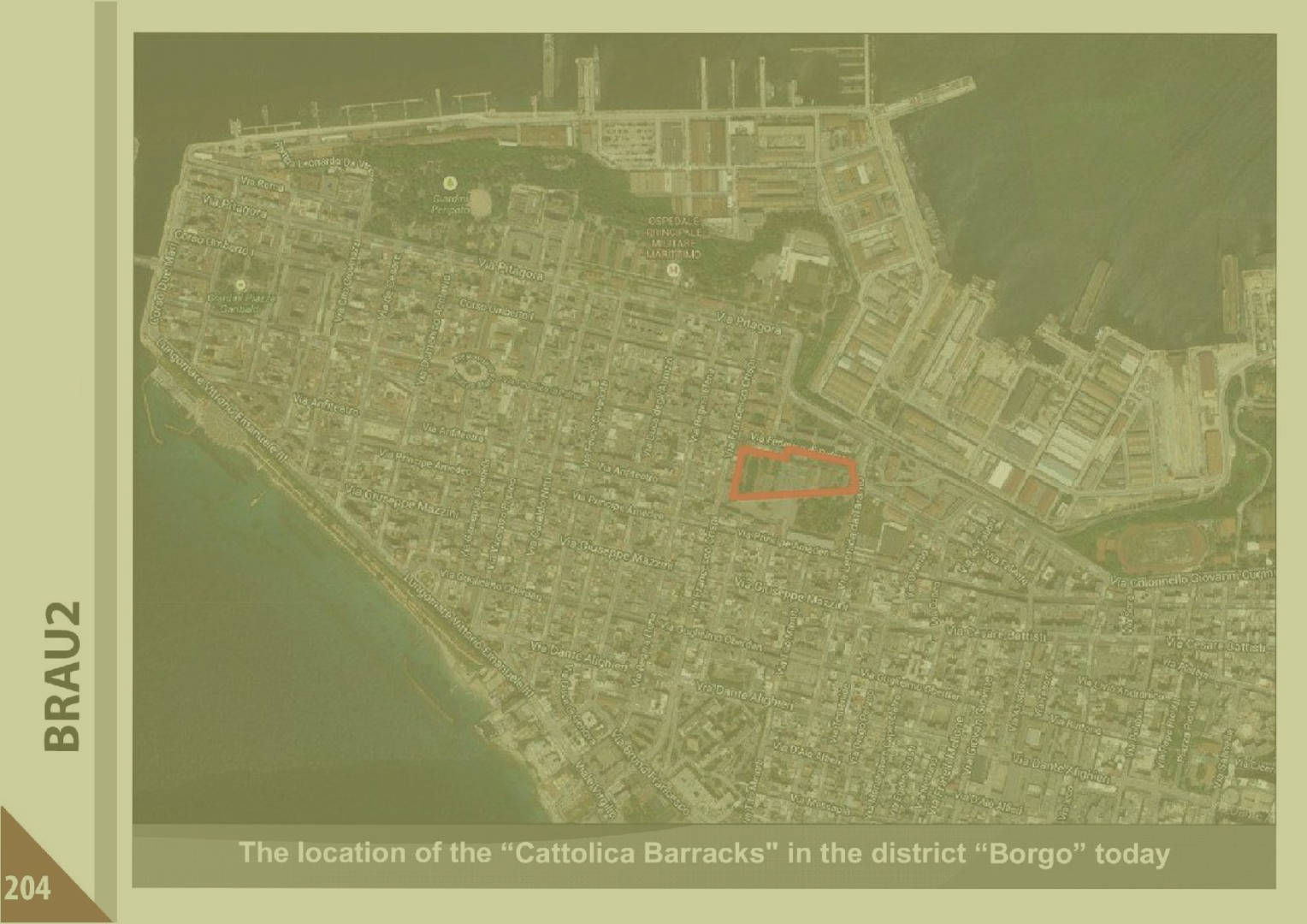
The cultural axis chosen for the 2nd Biennale on Architectural and Urban Restoration is the axis BRINDISI- ISTANBUL, along the New Via Egnatia, an infrastructure project implemented by the EU and inaugurated last year, a millenary E.O. route of communication, across  the northern Adriatic and the Aegean, that the Romans had built in the second half of the second century a. C.


cultural_axis

The cultural axis chosen of BRAU2 involves various countries of the Balkans of two multi-node networks, so called "corridors" of communication and transportation of persons and goods, provided by the EU, which connect countries of Central Europe with those of Eastern European and Mediterranean countries . More precisely, the Corridor V and Corridor VIII.


foto1

As regards the New Egnatia route, this affects the Balkan countries but remains slightly more northerly than the route realized by the Roman Genius, that ended ​​in Constantinople.

These routes or ancient roads, basically live still on today, considering that - after the Berlin Wall fell - were resolved all the policy issues that prevented the free movement of vehicles and of people in Europe. In reality, they are essentially revived the ancient criteria of Roman roads, revised according to the socio-economic contests in force in the host countries. Europe, in short, has not invented anything  in its  south-eastern lands; it has wisely limited to replicate in a modern key, the urban and geopolitical genius of the Romans, of two thousand years ago.

The highway which we travel today, on the New Egratia Route, connect Brindisi (Italy) to Igoumenitsa (Greece) after crossing a trait of Ionian Sea, continuing with a path of great enviromental and· archaeological· fascination, through the mountains of Epirus and particularly of Ioannina.


foto2c

The exhibitions and collateral events will involve the Balkan countries that flanked the cultural axis of BRAU2, and mainly Greece, Bulgaria, Macedonia, Albania, Croatia, Bosnia-Herzegovina, Serbia, Montenegro, countries where they operate CICOP Centres and National Delegations of CICOP. Net Confederation, network in wich also CICOP.Italy  pertains. The cultural axis will take as starting point the city of Brindisi and ends in Istanbul, but will also involve the North African countries bordering the Balkans, because of the contribution to the Mediterranean culture, derived by migration.


BRAU - Biennale © 2011